Volvo Amazon shares the wheelbase, tall posture and high H-point seating of its predecessor, the PV444/544, and was offered in two-door sedan, four-door sedan, and five-door wagon body styles - all noted for their ponton styling.
When introduced, the car was named the Amason (with an 's'),[7] deriving from the fierce female warriors of Greek mythology, the Amazons.
The Amazon was originally manufactured at Volvo's Lundby plant in Gothenburg and subsequently at the company's Torslandaverken plant,[9] which began operating in 1964.
The Amazon sedan's ponton genre, three-box styling was inspired by US cars of the early 1950s, strongly resembling the Chrysler New Yorker sedan and the Chrysler 300C hardtop Coupe.
The Amazon features strong articulation front to rear, pronounced "shoulders", and slight but visible tailfins.
The station wagon (estate) version was introduced at the 1962 Stockholm Auto Show, and Volvo manufactured 73,000 examples between 1962 and 1969.[13]
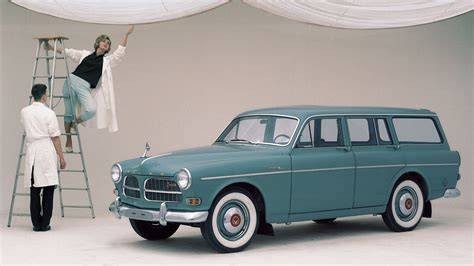
The Amazon estate features a two-piece tailgate, with the lower section folding down to provide a load surface and the upper section that hinged overhead. The vehicle's rear license plate, attached to the lower tailgate, could fold "up" such that when the tailgate was lowered and the vehicle in use, the license plate was still visible. This idea was used by the original 1959 Mini.
Under prototype designation 1200, following the PV444's internal designation as the 1100,[8] the Amazon was released in the press in February 1956, with production initially set to begin in July of the same year, and deliveries commenced in August 1956 - under the now modified internal designation 120 series.
Further iterations included the 121, the base model with a single carburetor 66 bhp (49 kW) engine, the 122S introduced in 1958 as a performance model equipped with a dual carburetor 85 bhp (63 kW) engine.
The Amazon's handbrake location, outboard of the driver's seat, was intended to accommodate subsequent bench seat models with column shift transmissions- these were produced in small numbers and made available to certain export markets.
The Volvo Amazon in station wagon form would become the first foreign market police car introduced to any police force of the United Kingdom in 1965.
< tagimg>Hampshire Constabulary Volvo Amazon police car at depotHaving trialled it against a Citroën DS19 Safari and Humber Super Snipe station wagon, Hampshire Constabulary purchased a white Volvo Amazon 1800 station wagon with a Ruddspeed upgraded engine initially for use as an accident tender, carrying equipment used by the police when attending scenes of road accidents, before transferring onto traffic policing duties alongside the Humber Super Snipe.
In 1966 the Volvo PV ended production, replaced by the Amazon Favorit, a less expensive version of the Amazon, without exterior chrome trim, a passenger-side sunshield or cigarette lighter, and with a three-speed rather than four-speed transmission - available in black with red interior and later white or black with red interior.[8]
The newer Volvo 140 was becoming the company's mainstream model, and the last of the four-door 120 saloons were produced in 1967.[17]
In 1967 came the 123GT, which was a Model 130 with high-compression four-cylinder B18B engine (from the Volvo P1800), M41 gearbox, fully reclining seats, front fog and driving lights (on some markets), alternator, fender mounted mirrors, special steering wheel, dash with a shelf and tachometer, and other cosmetic upgrades.
In 1967 the 4-door saloon was discontinued due to the introduction of 140-series.
In 1969 the displacement of the old B18 engine was increased and the engine was called the B20.
Of note: Volvo Cars arriving in Canada at the port of Halifax, Nova Scotia would have the (not-yet-legal) radial tires removed and replaced with bias-ply tires of-the-day before being accepted by DOT for delivery.
Also, the European 'Flash-to-Pass' feature of the turn signal toggle would be disconnected for the British market as it did not have Department of Transport approval.
Somehow, whereas most North American vehicles would only have lap safety belts until 1968, both driver and passenger got the 'three-point' shoulder belts, a Volvo safety feature. Fortunately, these remained in place for the new owners and doubtless saving many from death and injury from accidents.
Original specifications for the Amazon included the new Volvo B16 engine, a 3-speed manual gearbox (H6) and rear-wheel drive.
In 1958 the sport model, Amazon Sport, was released and later the same year the Amazon became the first series produced car with a three-point safety belt in the front seats as standard.
In 1962, Volvo introduced a two-door version, a five-door wagon, and the new B18 engine, deleting two-tone paint and upholstery.
In 1965 the Amazon color-coordinated embossed vinyl upholstery and door panels became available.
The new gearbox selections were the three-speed M30 (briefly offered with an automatic electric clutch), the four-speed M40 and the M41 with four-speed and overdrive. The M31 gearbox was also introduced in 1961 but was only available that year (a three-speed fully synchronized gearbox with overdrive on both second and third direct gears).
Gearbox options on the 121 were the M30, M31 and M40 while gearbox options on the 122S were the M40 and M41 gearboxes.
In 1964 the Borg-Warner BW35 three-speed automatic transmission also became available on the four-door and two-door.
↑ "Volvo assembly plants". www.volvoadventures.com. 8 August 2008. 1 2 3 4
"The Volvo Amazon: A Volvo beauty with mythological status turns 50". 1 2 3 4 5 6 7 8
Lindh, Björn Erik (1986). "The Amazon/120 - Beauty with Brown". Volvo The Cars from the 20s to the 80s. Förlagshuset Norden AB, Malmö. pp. 130-141. ISBN 91-86442-14-7.
the new model was still known as the 1200 (the old PV444 having been the 1200"; "the announcement of the new car was released in the press in February 1956," "to introduce the new Amason (spelled with an 's' rather than 'z'); "Volvo were hoping to market export versions with a bench-type front seat and a column-mounted gear lever, and a handbrake located in the middle would have been in the way."
"Amazon buyers began to receive their cars in February/March 1957, albeit at a very slow rate"; "The first Amazons were, in principle, not available in a single colour, although some were occasionally supplied. The cars were available in black and red with a light grey roof, and in light grey with a black roof. A dark blue finish with a light gray roof was added to the range in 1958"; "In the USA, the model was launched at the International Automobile Show in New York in April 1959"; "234,209 four-door, 359, 917 two-door and 73, 196 estate cars had been produced, 60% of them for export"; "the Company was unaware that Kreidler, the West German motorcycle manufacturer, had already registered the name. Following negotiations, the Company was permitted to use the name on the domestic market whereas, in other countries, the cars were known as the 121 or 122"; "The 1959 model (which appeared in August 1958) featured a major innovation in the form of front seat safety belts as standard equipment on all the cars, including the export models. Volvo was the world's first automaker to take this step, even though Ford fitted a "lap" belt on one or other of its cars in the middle of the 50s"; "Most of the external decoration (including the trim around the front and rear windows and along the gutters) was removed, while the interior was more austere, no sunshield being fitted on the passenger side and the cigarette lighter being omitted. There was only one technical modification; the normal 75hp engine was equipped with a three-speed fully synchronised gearbox.
↑ "From Mass-Market Cars to Niche Sports Utility Vehicles - The Volvo Torslanda Plant Turns 40". Swedespeed.com, 15 April 2004, Source: Volvo Car Corporation. ↑ "Så blev hon en bil" [How she became a car]. Aftonbladet (in Swedish). Archived from the original on 27 September 2006. Retrieved 8 July 2007. [Machine translation] The designer Jan Wilsgaard hand-picked directly from the Handicraft Society School (today HDK, School of Design and Crafts) and his own first major work was precisely the Amazon. He says in the aforementioned interview in the Classic Motor that one of the influences was American Kaiser, which he saw at the Gotheburg Port, quite close to where the Volvo factory was, in Lundby at Hisingen.
↑ "Global Viewpoints: Design roots". SAE.org, Automotive Engineering Online, Global View, April 2000. Archived from the original on 2016-03-03.
↑ "Volvo 122S: a rugged proved performer that even the toughest critics find difficulty in faulting". Life Magazine, 4 November 1956 (condensed from Car and Driver). Archived from the original on 3 March 2016.
↑ "The Amazon Estate (P220)- The First Major Step Towards the Five-Door Saloon" (PDF).
↑ Dan Carney (30 June 2007). "From the Past: Volvo 1800ES, Combination of a Wagon and Sports Car Flopped in the Market, but Became Influential". The Wall Street Journal.
↑ Anstead, Ant (2018). Cops and Robbers: The Story of the British Police Car. London: HarperCollins. pp. 157-164. ISBN 978-0-00-824451-4.
↑ Rosamond, Chris. "Bobby dazzlers: 50 years of Volvo police cars". Auto Express. Autovia.
↑ "Used car test: 1964 Volvo 122S B18". Autocar: 52-53.
Máte Volvo a chcete prodat? Kontaktujte nás. …
Švédská automobilka Volvo vznikla ve 20. letech minulého století. Prodejce ložisek Assar Gabrielsson zareagoval na silný nárůst automobilového průmyslu ve světě a přišel s nápadem založení švédské automobilky.
Nejnovějším trendem v typu karoserie, kterému se nevyhnula ani jedna z velkých automobilek, je kompaktní crossover. Tento typ karoserie poprvé Volvo uvedlo v roce 2017 s označením XC40.